Saturday was a free day, so I did what any good consumer would do and went shopping. In Camden markets, specifically. My God. There is no beginning and no end, so far as I can tell. I spent all afternoon wandering the stalls and shops and getting myself lost. Found several gifts for friends (and a few for myself) before finding my way out (a small achievement in itself) and heading back to the dorms.
Sunday I woke up bright and early for a long and arduous bus ride to Scotland. Ok, maybe it wasn't particularly arduous, but everyone on board was very tired. A few first impressions of Scotland: first, it is very beautiful and second, there is a lot of livestock. I don't know that I've ever seen so many sheep and cows in my life! In fact, I know I haven't.
We stayed in a town called Dalkeith, which is a sleepy little town outside of Edinburgh and a dramatic change from London. Dalkeith Palace, where we called home while in Scotland, was magnificent. Very old, very large, and very creepy when you're walking through the corridors at night trying to find your way back to your room. It reminded me a bit of The Shining. The grounds around the house were thick with woods and there were several muddy, sluggy paths leading through them. (Seriously, there were a lot of slugs.)
Sunday, July 18, 2010

Friday, July 16, 2010
Oxford
Today we visited the Bodleian Library at Oxford. The place has so much history, it's really overwhelming. The first building we entered first opened as a divinity school in 1488 and has beautiful late-Gothic architecture. The guide told us that the Bodleian is the oldest public library in Britain, and the second largest (after the British Library). The library acts as a depository in that they collect a copy of everything published in Britain as well as other items. They have material in 125 different languages. As if this weren't enough, some of the Bodleian's rooms were used in the filming of the Haarry Potter movies!

But back to the history. After some of the initial book-less rooms, we were taken into Duke Humphrey's reading room, which is the oldest in the library. Many of the books here are still chained to the wall as they were in the early days of the library. On the end of each shelf was a framed shelf lists which acted as the first library catalog, describing which books were held on that shelf. The Humphrey library was also one of the first galleried libraries in Britain. By putting the stairs to the gallery by the librarian's desk, the lirbarian could monitor who went up to the shelves; this also meant that those books would not have to be chained to the wall.
After the Humphrey's library were were led into underground tunnels that connect the old library to the new. The tunnels were originally used as air raid shelters, but fortunately, Oxford was never actually bombed during the war. (The guide explained to us that there is a rumor that the reason they weren't bombed is because Hitler wanted an honorary degree from Oxford.) Also in the tunnels is an old conveyor system that moves books between the libraries and is still in use.
Other than the library, the trip to Oxford was fairly uneventful. We traveled there by train from Paddington Station, which was nice if only because I was always a fan of the Paddington Bear books when I was a kid. They even had a kiosk selling Paddington Bear-related merchandise, and I ended up buying a new copy of the first book in the series. Once in Oxford, I wandered around with some of my classmates, going in some of the toursity shops and checking out the town on foot. After the library tour, we hit the Alice in Wonderland Shop (which was fun, though I didn't buy anything), grabbed dinner at a nearby pub, then grabbed the train back to London.
Image courtesy of bookpatrol.net
But back to the history. After some of the initial book-less rooms, we were taken into Duke Humphrey's reading room, which is the oldest in the library. Many of the books here are still chained to the wall as they were in the early days of the library. On the end of each shelf was a framed shelf lists which acted as the first library catalog, describing which books were held on that shelf. The Humphrey library was also one of the first galleried libraries in Britain. By putting the stairs to the gallery by the librarian's desk, the lirbarian could monitor who went up to the shelves; this also meant that those books would not have to be chained to the wall.
After the Humphrey's library were were led into underground tunnels that connect the old library to the new. The tunnels were originally used as air raid shelters, but fortunately, Oxford was never actually bombed during the war. (The guide explained to us that there is a rumor that the reason they weren't bombed is because Hitler wanted an honorary degree from Oxford.) Also in the tunnels is an old conveyor system that moves books between the libraries and is still in use.
Other than the library, the trip to Oxford was fairly uneventful. We traveled there by train from Paddington Station, which was nice if only because I was always a fan of the Paddington Bear books when I was a kid. They even had a kiosk selling Paddington Bear-related merchandise, and I ended up buying a new copy of the first book in the series. Once in Oxford, I wandered around with some of my classmates, going in some of the toursity shops and checking out the town on foot. After the library tour, we hit the Alice in Wonderland Shop (which was fun, though I didn't buy anything), grabbed dinner at a nearby pub, then grabbed the train back to London.
Image courtesy of bookpatrol.net
Thursday, July 15, 2010
The V&A Museum Library

Today I visited the Victoria & Albert Museum Library. The library is open to the public, but is a closed-access library; this means that while people can browse titles online, most of the actual books and materials will need to be retrieved by a librarian. One interesting aspect of the library is that they have no classification system--everything is shelved by size. Because most art books can be large or unusual sizes, this method is used to best utilize available shelf space. Another interesting fact about the library is that they never weed items, thus space is always an issue. This is further complicated by the fact that the museum will often fight them for space for its exhibits. The librarian showed us a room where library materials were in locked shelves along the walls, but a museum exhibit took up the central space in the room.
In addition to the regular art collection, the library also contains a special colelction. Some of the items include Leonardo da Vinci's notebooks, a first folio Shakespeare, and Dickens' manuscripts (among other things). These items can be pulled out for patrons but only if absolutely necessary and if the patron provides appropriate letters and credentials for needing to see the items. One way around this is items like da Vinci's notebook, of which they have a photocopy. That way they almost never have to pull out the original. A couple interesting items they showed us were "art books", which weren't books at all in the traditional sense, but works of art. One was bound comic book pages that had several pieces cut out, making the original story unreadable. Another looked more like a wooden box, but had text written all over the inside, and pieces that came out of it, such as a small scroll.
Other than visiting the library, I didn't spend too much time at the library. However, I did take the time to visit the Beatrix Potter exhibit. My mom read those stories so many times growing up that I was eager to see the original artworks. The exhibit was well done in that it had each original illustration with the text from the story underneath it; thus you could walk around the room and read the story while viewing the original artwork.
After the museum, a classmate and I went to Hyde park for a bit. The park is massive and I intend to go back as I only got to see a fraction of it. We followed the park trip with a quick dinner at a pub, and then we were off to see the Welsh band Los Campesinos! play a show. The show was a lot of fun, it was at a smaller venue and the crowd was really into it. I had seen the band once before (at last year's Lollapalooza) but seeing a band at a festival is a lot different from seeing them at one of their own shows.
Image courtesy of curiousexpeditions.org
Wednesday, July 14, 2010
Stratford-upon-Avon
Today we had a leisurely day trip to Stratford-upon-Avon, aka Shakespeare's birthplace. The only item on the agenda was a play in the evening, so a group of us spend the rest of the afternoon strolling around the town and shopping. (I bought a Shakespeare umbrella, among other things.) It was nice to have a library- and museum-free day. While there are several museums and places of interest in Stratford, some of my classmates and I decided to skip them. (This was based on the fact that so much of Shakespeare's life is speculation and so little is actually known that most of the museums seem like a bit of a waste; this was just the verdict we came to.)

The play in the evening was fantastic. Our class saw The Winter's Tale, which is a Shakespeare play that I was unfamiliar with. The set design was phenomenal. Most of it, such as the leaves on trees, were made up of book pages. Book pages also littered the stage and made up the costumes of some of the characters. At one point, a giant book page bear puppet (yes, you read that right) dragged off one of the characters, which was a cool effect (trust me on this).
Image courtesy of guardian.co.uk
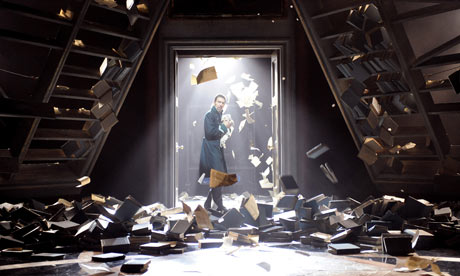
The play in the evening was fantastic. Our class saw The Winter's Tale, which is a Shakespeare play that I was unfamiliar with. The set design was phenomenal. Most of it, such as the leaves on trees, were made up of book pages. Book pages also littered the stage and made up the costumes of some of the characters. At one point, a giant book page bear puppet (yes, you read that right) dragged off one of the characters, which was a cool effect (trust me on this).
Image courtesy of guardian.co.uk
Tuesday, July 13, 2010
The London Library

Today we went to the London Library. Established in 1841, the London Library is an independent instituion funded primarily by member subscriptions. With former members including Charles Dickens, Virginia Woolf, Arthur Conan Doyle and Charles Darwin, the library has a strong literary history. Unlike libraries that use the Dewey or LC classification system, the London Library has a system that is entirely unique. Sir Charles Hagberg Wright, the librarian from 1893-1940, divided the collection into major subject areas and then alphabetized the works by the author's last name, or by title for edited works.
One interesting aspect of the library is that once a book is obtained, it stays. They never get rid of anything with the exception of duplicate copies of the same edition of a book. This creates obvious problems where space is concerned. Another problem is conservation. As the librarians emphasized, they are a library and not a museum. Thus, it's only the rarest and oldest of materials that are not allowed to be checked out. Everything else can go home with patrons. As a result, the library has a dedicated conservation department that repairs and maintains the books. This effort includes binding or rebinding around 4,500 books per year.
After the library, some classmates and I got dinner at a place called The Slug and Lettuce, which despite it's unappetizing name, had really good food. Later in the evening, I went with a group of people to see We Will Rock You, which is a silly musical featuring the music of Queen. While the storyline was ridiculous, the music was fantastic (it's Queen, after all) and the crowd was really into it. At the end of the show, the actors took their bows and a large screen on stage came on and read "You want to hear Bohemian Rhapsody?" (the song still hadn't been performed). The crowd went nuts. The screen changed, reading "Oh, alright then." At which point the cast came back out to perform "Bohemian Rhapsody". The audience went wild. Despite the ridiculousness of the story, it was a really fun show.
Image courtesy of ianvisits.co.uk
Monday, July 12, 2010
The Caird Library

Today we visited the National Maritime Museum's Caird Library. The Caird library is open to the public and is one of the largest maritime libraries in the world. In addition to maritime-related materials, the library's collection also focuses on emigration, navigation, piracy, astronomy, exploration and naval architecture. As part of a national museum, the library receives public funding. The librarian leading the tour explained that while the library is currently somewhat hidden, they will soon be moving to a new building where they hope to increase visibility and the number of users.
Of the many interesting items they pulled from their archives to show us, the two I found most interesting were a naval atlas from 1686 and a book of signal codes from 1800. Part of my interest is due to the fact that both were plundered from other ships. The naval atlas was copied by Basil Ringrose from one that was pirated from the Spanish. The book of signal codes came from the USS Chesapeake and was obtained when the British attacked the ship. What was particularly unusual about the the signal code book was that the spine was fitted with several lead weights; the information in the book was so important that in the event of an attack the owner should have thrown it overboard. The lead weights were to help it sink. Unfortunately, whoever was in charge of the book didn't do this and code book now belongs to the Caird library. I love that in both of these situations, information was one of the most valuable things obtained.
After the tour, I checked out the museum's toy boat exhibit, and then hiked up the hill to see the Prime Meridian and the Royal Observatory. The view was fantastic. I spent most of the rest of the day running errands, but later in the evening went to see Predators, which I absolutely loved. Highly recommended for fans of the original!
Image courtesy of the National Maritime Museum website.
An American in Paris

First, library stuff. After a somewhat miserable journey to Paris, one of the first places I had the opportunity to visit was the American Library in Paris. What began as a private book service for American soldiers in WWI is now the only large, English language library in continental Europe. As such it caters to a variety of users--ex-pats, English speakers in the area, students and professors of American studies. Sometimes academics will even visit the library from abroad. The librarian who spoke with us described the library's functions as a sort of hybrid; the library looks and feels much like a public library, but tries to act as an academic library. The collection consists of popular titles for books, magazines and newspapers, and also academic titles dealing with American culture, social sciences and literature. Because the library is a private institution, they must do all their own fundraising and require an annual fee of 100€ from their users. The library also serves as a kind of community center, offering a variety of programming for children and adults, including movie nights, exhibits, lectures and so on.
After the library tours, I feel like my trip to Paris began in earnest. We went to dinner at a traditional French bistro where I had French onion soup (despite the 90 degree heat), beef with shallots (which were carmalized to perfection--I could have eaten them by themself) and the best creme brulee I've ever had. Exhausted, I headed back to the hotel after dinner.
The following day (after a croissant and cafe au lait) I set out with a group to the Palace of Versailles. Wow. The immensity and opulence of the place is simply staggering. While I took several pictures, I don't know that any of them do the place justice. Not only is the palace incredible, but the gardens seem to go on forever. The view is spectacular. After attempting to comprehend Versailles, we returned to Paris where I wandered around with a classmate, stopped for crepes, and eventually made our way back to the Eiffel Tower, where the whole group was meeting to go on a riverboat cruise that night. It was touristy, but it was a wonderful way to see the city at night. Watching the Eiffel Tower sparkle was fantastic.
On our last day in Paris, a classmate and I set out early for the catacombs. The catacombs were eerie. A seemingly endless stone spiral staircase leads you deep underground, and after seeing some preliminary information about the catacombs you wander further and all the walls are made out of human bones. Layers of skulls are stacked on top of layers of other bones. In some areas, the skulls form a design. It's dark down there. And the low ceiling drips water. It was terrifically creepy and I'm so glad I got to go (oddly, it was at the top of my to do list in Paris). After, we wandered around Paris and stopped in a bakery where I ate the most beautiful dessert of my life. It was raspberry mouse wrapped in a kind of cup made out of striped red and white cake, topped with a sort of jam and chopped pistrachios. It was marvelous.
While I didn't get to see everything Paris had to offer, I'm very glad I went and have every intention of going back.
Photo courtesy of Flickr user Monceau
Subscribe to:
Posts (Atom)